




























The Islamic Support for the First Crusade
Introduction
This article presents evidence for the Islamic support for the First Crusade. I am writing this because everyone I have spoken to about this subject was surprised to hear that this support existed. In my experience the modern popular retelling of the Crusades does not mention it or at most says there were divisions in the Islamic world.
The goal of this article is to make people aware of the primary documents and hear what academics say about this subject.
I am suggesting that this Islamic support is an important fact that needs to be included in our popular retelling and discussion of First Crusade.
Summary
After the Seljuk Turks converted to Islam in Central Asia they took up the mantle of Jihad for Islam. This included fighting the Christians of Anatolia (modern Turkey) with the specific goal of taking Constantinople. It was because of this military pressure that the Byzantine Emperor, Alexius I, requested military support from Pope Urban II and Western Europe. But the Turkish Jihad was equally aimed at certain Muslims, in this case the Fatimid Muslims of Egypt.
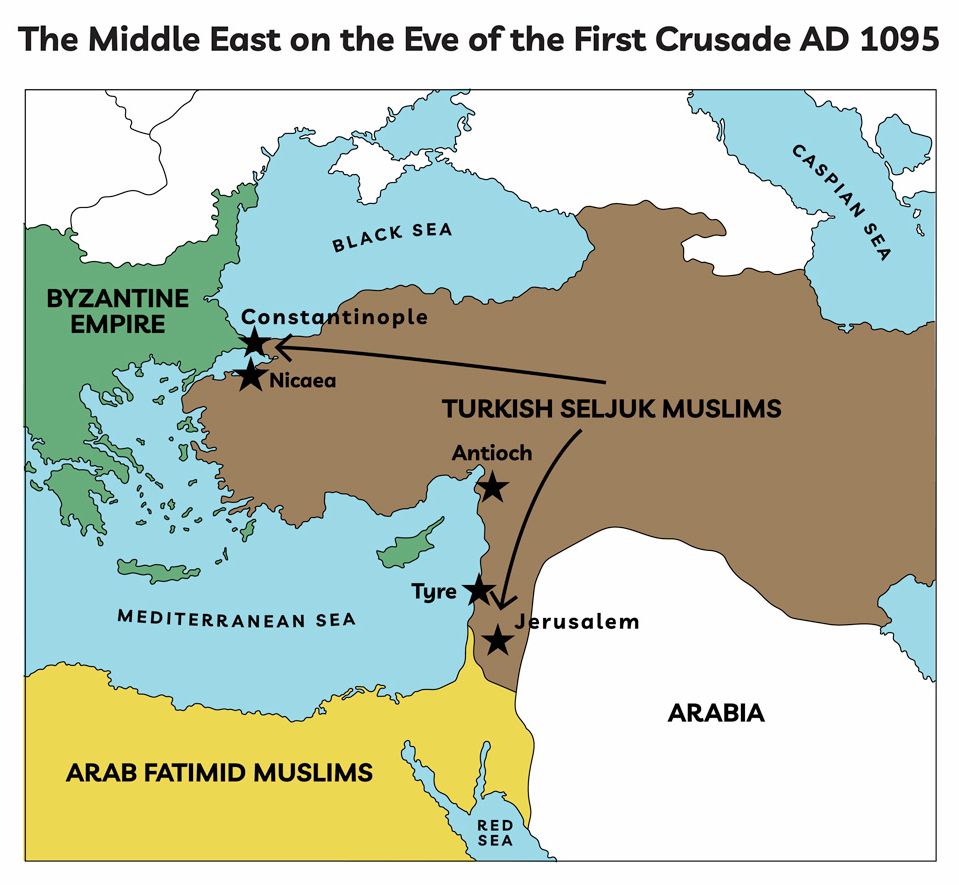
The Arab Fatimid Muslims were relatively moderate and had settled into peaceful relations with the Byzantine Christians. Like Alexius I, they too wanted an alliance with the Crusaders to fight against their common enemy, the Seljuk Turkish Muslims. Negotiations between the Fatimids and Crusaders went on for several years with ambassadors from both sides visiting and supporting each other.
After the Crusaders' victories at Nicaea and Antioch, the Turkish military was weakened and this allowed the Fatimid Muslims to take Jerusalem from the Turkish Muslims. However, the Crusaders primary goal was Jerusalem. Negotiations continued between the Fatimids and Crusaders but in the end a deal was not reached, the ownership of Jerusalem being the sticking point. The previous peaceful relations and support between them fell apart and the Crusaders took Jerusalem from the Fatimids in 1099.
Islamic Primary Documents
Ibn al-Athir (AD 1160–1233). Who is Ibn al-Athir?
For his history of the Crusades Ibn al-Athir was an eye-witness, although not always a sympathetic one, of Saladin’s career, and made use of Ibn al-Qalanisi, Baha’ ad-Din and `Imad ad-Din as sources. The clarity and simplicity of his style, which avoids archaisms and embellishments and aims at presenting the essential facts, has contributed to his reputation as the chief historian of the later Crusades.1
Ibn al-Athir records the following interaction between the Fatimids and Crusaders.
It has been said that the Alid rulers of Egypt became fearful when they saw the strength and power of the Saljuq state, that it had gained control of Syrian lands as far as Gaza, leaving no buffer state between the Saljuqs and Egypt to protect them, and that Aqsis had entered Egypt and blockaded it. They therefore sent to the Franks [Crusaders] to invite them to invade Syria, to conquer it and separate them and the [other] Muslims, but God knows best.2
Crusader Primary Documents
The Letter of Count Stephen to his wife, written March 29,1098, while the Crusaders were besieging Antioch.
The [Muslim] emperor of Babylon also sent Saracen messengers to our army with letters and through these he established peace and concord with us.3
William, Archbishop of Tyre (d. 1186) was born in Jerusalem and wrote a history of the Crusades.
Moreover, the caliph of Egypt, the most powerful of all the infidel potentates because of his riches and military forces, had sent his envoys to our [the Crusade] leaders. The reason for this embassy was as follows. For many years, a deep and inveterate enmity had existed between the Orientals and the Egyptians, arising out of differences in their religious beliefs and their opposite dogmas. This hatred has persisted without interruption to the present day. Thus these two kingdoms, often at war with one another, were in constant rivalry, each striving to extend its own boundaries and to reduce the limits of the other, as was carefully explained in the first book of this history. At different periods, according to the prowess, now of the former and now of the latter, gained the upper hand, each kingdom, with the success of its arms, expanded its territory. The result was that whatever increased the domains of one kingdom decreased that of the other.
At this period, the prince of Egypt held possession of all the country from the land of Egypt even to Laodicea of Syria - a journey of thirty days. But for a short time before the Christians arrived, as we have already stated, the sultan of Persia had seized Antioch, which lies on the frontiers of the Egyptian kingdom, and had occupied all the country as far as the Hellespont. The Egyptian monarch regarded with suspicion any increase of the Persians or Turks. Accordingly, the news that Qilij Arslan had lost Nicaea, where his army was reported to have been badly treated, and also that the Christians had laid siege to Antioch pleased him greatly. He regarded the losses of the Turks as a gain for himself and their troubles as affording peace and safety for himself and subjects. Fearing, therefore, that weariness of the long-continued siege might cause our people to fail, he sent envoys, members of his own household staff, to beg the leaders to continue the siege. The deputies were commissioned to assure the Christians that the sultan would aid them with military support and resources. They were also to try to win the hearts of favor of the leaders and to close a treaty of friendship with them.4
Albert of Aachen (fl. c. 1100) was a historian of the First Crusade and the Crusader kingdom of Jerusalem.
When this long siege [of Antioch] had gone on for some time, and the people had undergone very heavy punishment in terms of the burden of keeping watch, of famine and disease and frequent Turkish attacks the king amir of Egypt, because there had been very severe discord and hatred between him and the Turks long before this expedition of the Christians, and knowing the Christians’ intentions by means of a certain abbot sent as emissary, sent fifteen envoys who were skilled in different languages to the army of the living God, about a mutual alliance for peace and his kingdom, bearing this message:
‘The marvelous king of Egypt, who rejoiced at your arrival and that you have done well so far, sends greetings to the great and small princes of the Christians. The Turks are a race foreign to me and dangerous to my kingdom; they have frequently invaded our lands and held on to Jerusalem, a city which is subject to us. But now with our forces we have recovered this city before your arrival, we have thrown out the Turks, we have struck a treaty and a friendship with you, we shall restore the holy city and the Tower of David and Mount Sion to the Christian people, and we shall have discussions about acknowledging the Christian faith. If, when we have discussed it, it pleases us, then we are prepared to embrace it. If, however, we should persist in the law and the ritual of the gentile faith, yet the treaty which we have between us shall not be broken. We entreat and warn you not to withdraw from this city of Antioch until that which was unjustly stolen is restored to the emperor of the Greeks and to the Christians.’5
I will now show that the summary and primary documents I have provided are accepted by Western, Arab and Islamic scholarship.
Modern Western Scholarship
For Western scholarship we will consider Christopher Tyerman, God’s War - A New History of the Crusades.6
The Context of the First Crusade
The Turkish invasions from the 1050s destabilized the region, introducing an alien ruling elite backed by military coercion, causing as much if not more mayhem and disruption than the crusaders were able to achieve. (Tyerman, p. 13)
One characteristic of the Seljuks was their fiercely orthodox Sunni Islam, putting them at odds with many of their subjects, not only the various Christian sects but also the Shi'ite majority among the Muslim peasantry of Syria, as well as with the heretical caliphs of Egypt, with whom they contested control of Palestine. (Tyerman, p. 127)
The Egyptian rulers were less ideologically militant or successful, their hold over the hinterland of Syria and Palestine reduced to nominal control over a few sea-ports on the Palestinian littoral. In an attempt to eject Turkish authority from Palestine Badr al-Jamali's son and successor, al-Afdal, sought friendship with Byzantium and an agreement with the Greeks' newest allies in 1097-9. (Tyerman, p. 128)
After the Crusader’s victory at Nicaea, Alexius I, organized for the Crusaders and Fatimids to negotiate.
When the emperor [Alexius I] assembled his allies at Pelekanum after the siege [of Nicaea], apart from extracting oaths from recalcitrants such as Tancred of Lecce, giving advice, discussing strategy and showering rich and poor alike with gifts, he arranged for a crusader embassy to be despatched to negotiate with the Fatimid regime in Egypt, fellow adversaries of the Turks, with whom he was on amicable terms. (Tyerman, p. 124)
By the winter of 1097-8, the resources of many of the lesser and some of the greater leaders of the [Crusader] armies were reaching exhaustion. Negotiations with the Fatimids of Egypt continued: an Egyptian embassy arrived at the crusader camp in February 1098. (Tyerman, p.136)
Some optimism for the future may have been derived from the negotiations with Egyptian ambassadors in February and March 1098 and the dispatch of Christian envoys to accompany the Egyptians back to Cairo. (Tyerman, p. 140)
The Crusaders' victory over the Muslim Turks at Antioch allowed the Fatimid Muslims to retake Jerusalem from the Turks, however, Jerusalem was the goal of the Crusaders. Discussions between the Crusaders and the Fatimids continued regarding Jerusalem, but there was no agreement. Both sides wanted Jerusalem. The alliance fell apart and the Crusaders fought the Fatimids for control of Jerusalem, and took Jerusalem from them.
Negotiations with the Fatimids continued, the Egyptian embassy at Antioch being accompanied back to Cairo by the Christian ambassadors. The defeat of Kerbogha had helped the Fatimids recapture Jerusalem in July 1098 from his allies, the Ortoqids, radically reconfiguring the diplomatic and political map. Instead of making common cause against Turkish interlopers, the westerners' ambition now threatened the integrity of Egyptian conquests in Palestine. Negotiations continued until May 1099, with Christian envoys even celebrating Easter 1099 at the Holy Sepulchre in Jerusalem. (Tyerman, p. 149)
At this moment, the ambassadors from Egypt returned with al-Afdal's proposal for limited access to Jerusalem by unarmed Christians. While the westerners may have agreed to partition Palestine, leaving them control of the Holy City, this offer was impossible. (Tyerman, p. 152)
Modern Arab/Islamic Scholarship
I consulted four books written by Arab/Islamic scholars.7 All of them had sections on the alliance between the Fatimids and Crusaders. Here are two examples:
S.E. Al-Djazairi
The Muslim world, in the same 11th century, was ridden with divisions and conflict. Muslim rulers were ready to form alliances with the foe against other Muslims. The loss of Sicily and al-Andalus was the direct result of Muslim collaboration with invading Christian forces. In the East, Ibn al-Athir says:
‘Another story is that the Fatimids were afraid when they saw the Seljuk extending their empire through Syria as far as Ghaza, until they reached the Egyptian border and Atsiz (a Seljuk general) invaded Egypt itself. They (the Fatimids) therefore sent an invite to the Franks to invade Syria and to protect Egypt from the Muslims. But God knows best.’8
Amin Maalouf
Since the middle of the century, Seljuk advances had been eroding the territory of the Fatimid caliphate and the Byzantine empire alike. While the Rum [Byzantine] watched as Antioch and Asia Minor escaped their control, the Egyptians lost Damascus and Jerusalem, which had belonged to them for a century. A firm friendship developed between al-Afdal and Alexius, and between Cairo and Constantinople. There were regular consultations and exchanges of information; common projects were elaborated. Shortly before the arrival of the Franj [Crusaders], Alexius and al-Afdal observed with satisfaction that the Seljuk empire was being undermined by internal quarrels. In Asia Minor, as in Syria, many small rival states had been established. Had the time come to take revenge against the Turks? Would the Rum and Egyptians now both recover their lost possessions? Al-Afdal dreamed of a concerted operation by the two allied powers, and when he learned that the basileus [king] had received a large reinforcement of troops from the lands of the Franj, he felt that revenge was at hand.
The delegation he dispatched to the besiegers of Antioch made no mention of a non-aggression pact. That much was obvious, thought the vizier. What he proposed to the Franj was a formal partition: northern Syria for the Franj; southern Syria (meaning Palestine, Damascus, and the coastal cities as far north as Beirut) for him. Al-Afdal was careful to present his offer at the earliest possible date, before the Franj were certain that they would be able to take Antioch. He was convinced that they would accept with alacrity.9
Conclusion
We have considered the primary documents, Western, Arab and Islamic scholars, and seen that a significant part of the Islamic world supported the First Crusade and sought to work with it. If you are going to tell the story of the First Crusade then you need to include this; to leave it out misrepresents the First Crusade.
- 1
Francesco Gabrieli, Arab Historians of the Crusades, New York: Dorset Press, 1989, p. xxviii.
- 2
The Chronicle of Ibn al-Athir for the Crusading Period from al-Kamil fi'l-Ta'rikh Part 1: The Years 491-541/1097-1146 - The Coming of the Franks and the Muslim Response, translated by D.S. Richards, New York, USA: Routledge, 2016, pp. 13-14.
- 3
- 4
William Archbishop of Tyre, A History of Deeds Done Beyond the Sea, translated by Emily Atwater Babcock and A.C. Krey, USA: Columbia University Press, 1943, book 4, pp. 223-224. archive.org/details/williamoftyrehistory/page/n233/mode/2up
- 5
Albert of Aachen's History of the Journey to Jerusalem, translated and edited by Susan B. Edgington, Surrey, England: Ashgate Publishing Limited, 2013, vol 1, bk 3:59, p. 123.
- 6
Christopher Tyerman, God’s War - A New History of the Crusades, London, England: Allen Lane, 2006.
- 7
Amin Maalouf, The Crusades through Arab Eyes, New York, USA: Schocken Books, 1984.
Prof. Masud ul Hasan, History of Islam, Delhi, India: Adam Publishers & Distributors, 2002.
Tamim Ansary, Destiny Disrupted - A History of the World Through Islamic Eyes, New York, U.S.A.: Public Affairs, 2009.
S.E. Al-Djazairi, The Crusades, Manchester, UK: The Institute of Islamic History, 2007. - 8
S.E. Al-Djazairi, p. 52.
- 9
Amin Maalouf, p. 45.